Making Efficient High-Fidelity Acoustic Analysis A Reality!


Sample Video Clips of the BEM Animation Results Using the FastBEM Acoustics® Software:


Other Examples:

A few examples are presented below to further demonstrate the capabilities of the FastBEM Acoustics® software. The examples are solved on a Dell® Vostro 200 desktop PC with Intel® Core2 Duo 2.2 GHz CPU and 4 GB RAM. The tolerance for convergence is set at 1.E-4. To see larger and better-quality plots, click on the images.

A. Radiating Sphere Model

A radiating sphere of radius R is used to show the accuracy and efficiency of the FastBEM Acoustics® software (More verification cases can be found in the User Guide and the related papers listed in the References page). In this case, a monopole source is placed at the location (R/2, 0, 0) to generate the velocity BCs on the sphere and the exterior field is solved using the code. The number of boundary elements (= DOFs) increases from 588 to 2,017,200. The non-dimensional wavenumbers ka = 2 and 20. The following two contour plots show the sound pressure on the surface of the sphere and a field surface, respectively, at ka = 20 and with 10,800 elements (Click the images to see larger plots).


Plots of relative errors in the computed sound pressure and power and the CPU time are shown in the following two figures and are compared with those of the conventional BEM. The accuracy of the FastBEM Acoustics® is quite satisfactory considering the tolerance (1.E-4) used for convergence. The errors decrease quickly and stay around 0.2% for models with more than 100,000 DOFs at ka = 2, indicating the numerical stability of the algorithms. The CPU time for the FastBEM Acoustics® code increases almost linearly with the increase of the DOFs and the largest BEM model with 2 million DOFs is solved in 65 min. at ka = 2 (This is a system of equations with complex variables, which is equivalent to a system of 4 million DOFs in real variables!). The conventional BEM, however, can only solve BEM models with up to 10,800 DOFs and the CPU time used increases almost as a cubic function of the DOFs. The advantages of FastBEM Acoustics® as compared with the conventional BEM are evident in terms of both the computing speed and memory usage.


B. Engine Block Model

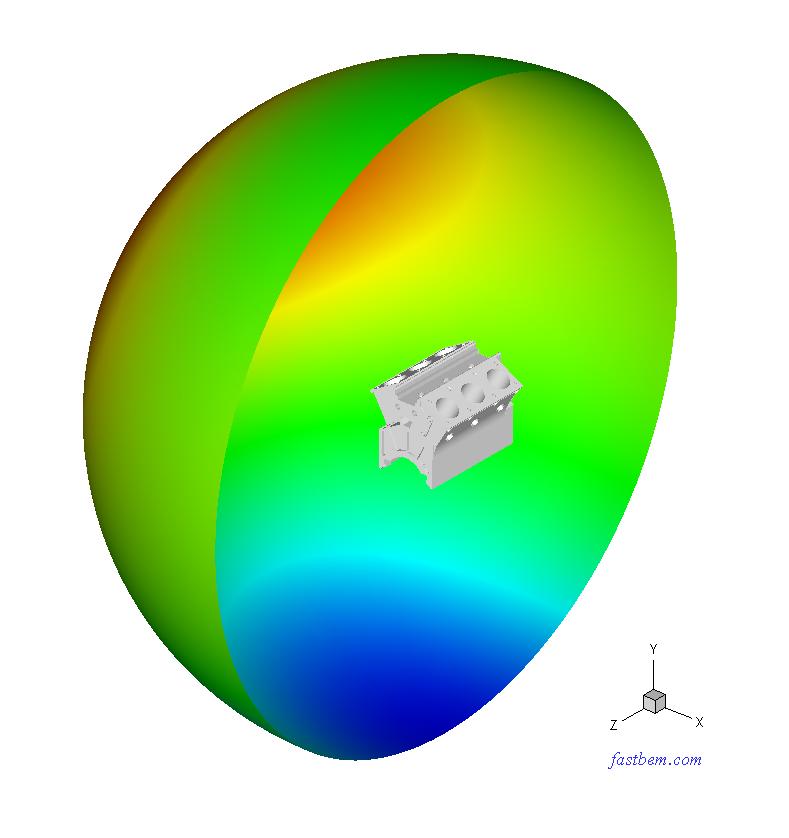
An engine block is modeled with 132,764 boundary elements. The largest dimension of the engine model is 360 mm. Velocity boundary conditions are applied to the surface of the engine block. The acoustic pressure on the surfaces of the engine block and a field surface surrounding the engine are computed at ka = 3.6 (f = 546 Hz). The model is solved in 60 min. using the PC. The plots of the acoustic pressure on the surface of the engine block and the field surface are shown below.


C. Wind Turbine Model

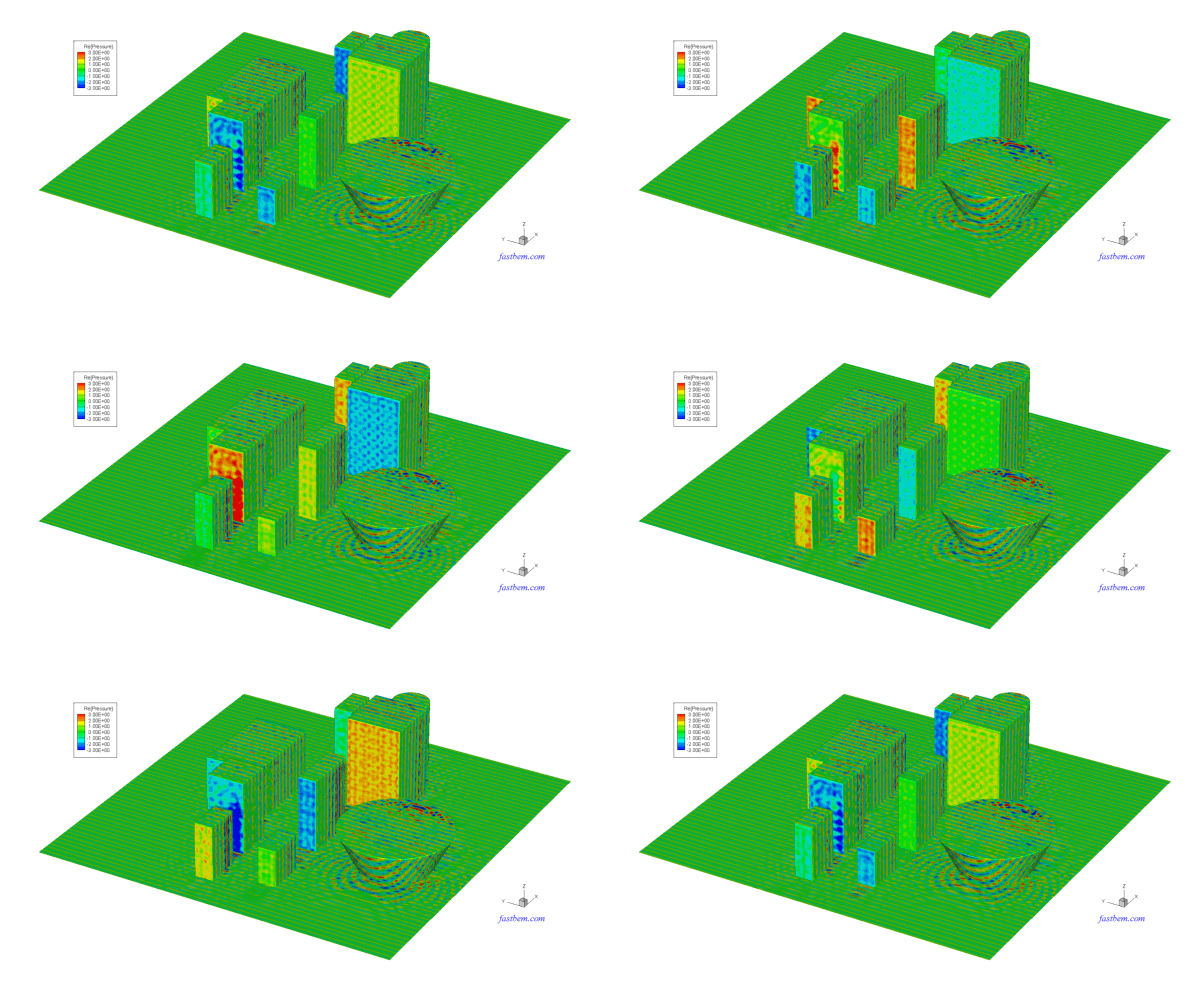
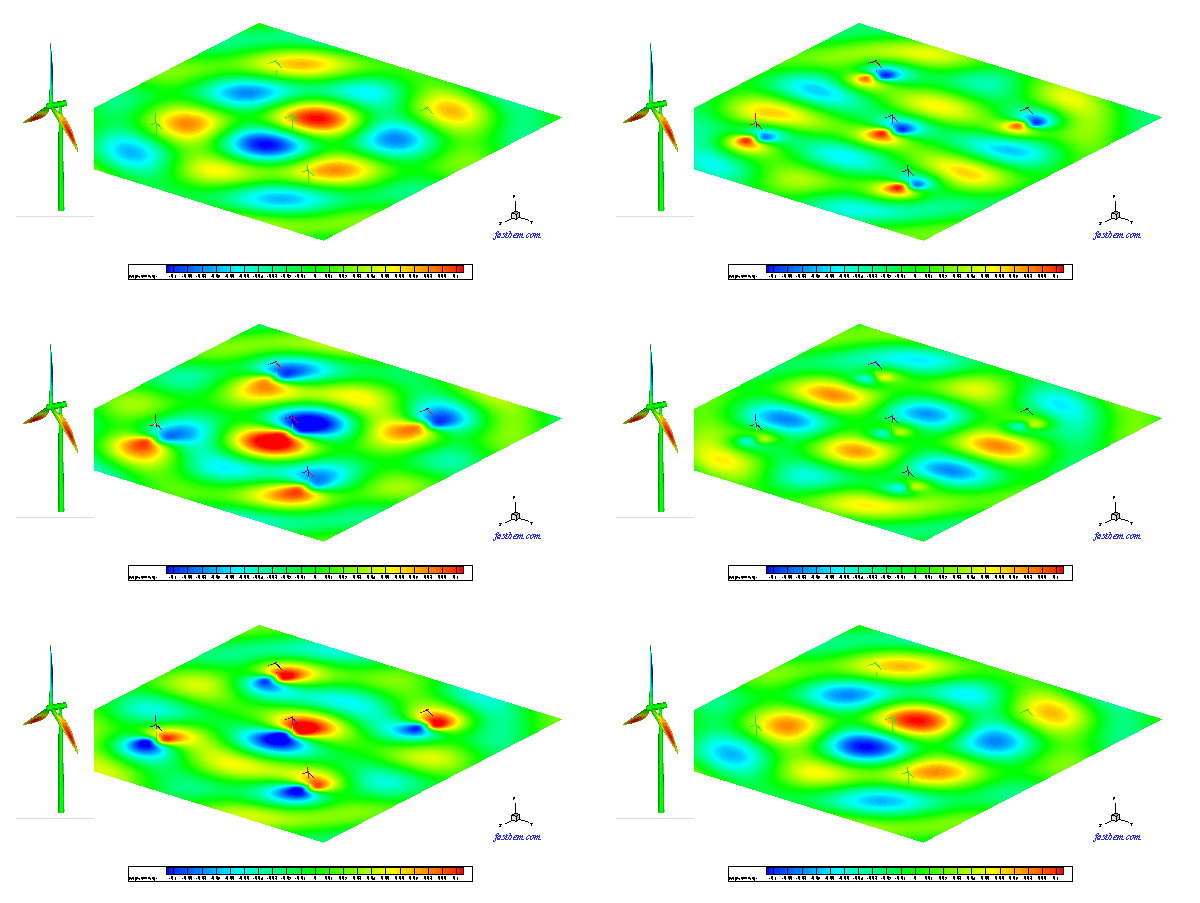
This is a half-space acoustic BEM model used to predict the wind turbine noise. In this example, five wind turbines are modeled with 557,470 boundary elements. All the turbines have a height of about 29 m and are spaced 50 m apart in the x- and y-directions. The ground is modeled as a rigid infinite plane where no elements are applied because of the use of the half-space Green's function in the code. The sound pressure on the surfaces of the turbines and a field surface of the size 200x200 m^2 on the ground are computed using the FastBEM Acoustics® software at ka = 5 (representing a rotating speed of 3 cycles/s for the blades). This BEM model is solved in 108 min. The sound pressure on the surface of the turbines and the field surface are plotted below.


D. Skipjack Submarine Model

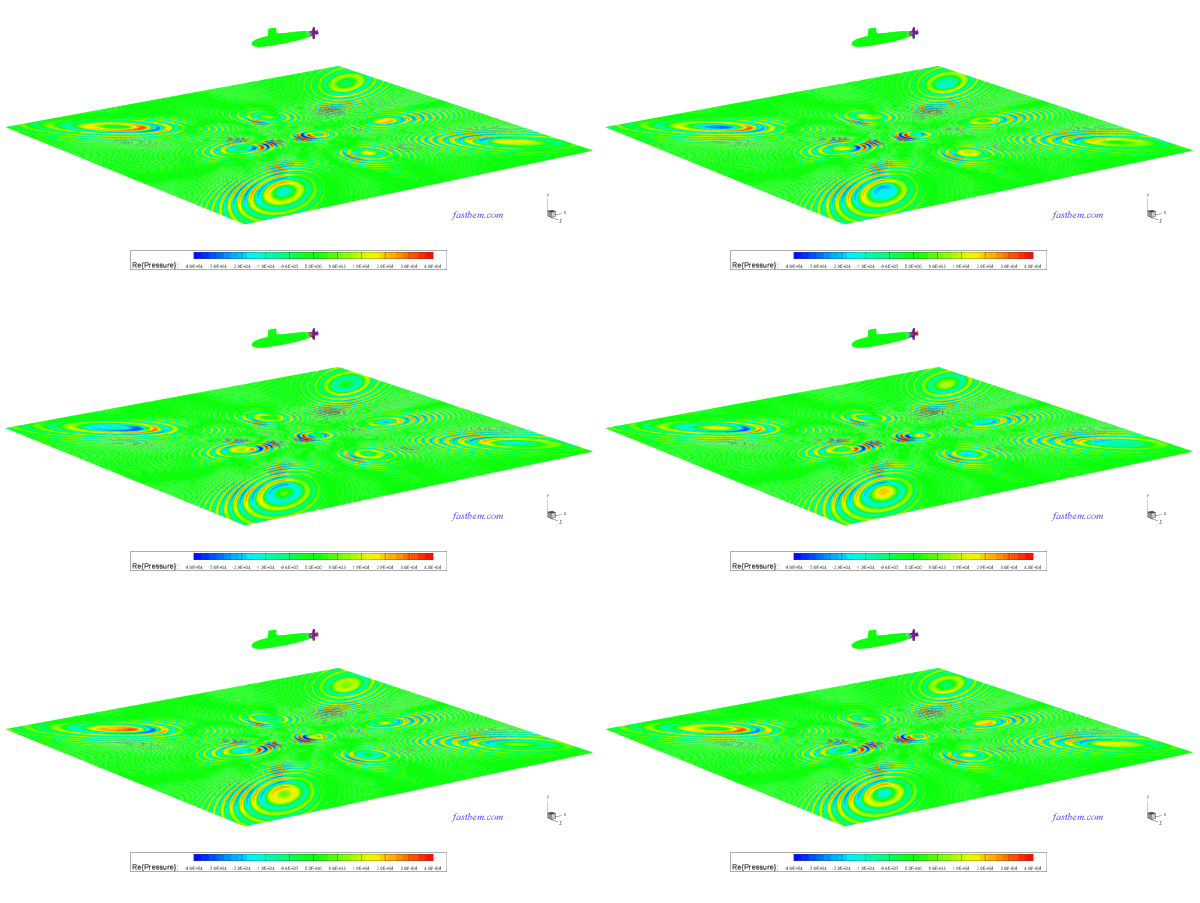
There are 250,220 DOFs in this model of the Skipjack submarine immersed in water in an infinite space. The sound pressure on the surface of the submarine due to the rotation of the propeller and an incident wave in the (1, 0, -1) direction at ka = 383.7 (f = 1233 Hz) is computed using the FastBEM Acoustics® software. The model is solved in 85 min. on the PC. The mesh plot and plots of the acoustic pressure on the surface of the structure and a field surface are shown below.


E. Airbus A320 Model

There are 541,152 elements for this Airbus A320 model. The acoustic pressure field on the surface of the aircraft due to the vibrations of the two jet engines is computed using the FastBEM Acoustics® software at ka = 12.3. The model is solved in 54 min. using the PC. The mesh plot and the surface acoustic pressure plot are shown below.